


Quick Answer: What Is the Most Practical Way to Extend Walkie Talkie Coverage?
A walkie talkie repeater receives a handheld radio signal on an input frequency and retransmits it on a separate output frequency, allowing two radios to communicate through a higher and better-positioned site. In a flat, open deployment, a rooftop or hilltop repeater can extend a system from short handheld-to-handheld communication to a larger operational area; the actual result depends on antenna height, terrain, building obstruction, frequency allocation, antenna losses, radio power and site engineering.
For a commercial fleet covering a port, mine, industrial park, farm or large estate, a repeater-based two-way radio system is often more controllable than simply buying higher-power handheld radios. QYT can supply compatible handheld and mobile radio endpoints from its CB, KT and M series, subject to the allocated band and confirmed product configuration, and can prepare channel programming for bulk orders when the buyer supplies the approved frequency plan.

Why Should B2B Buyers Evaluate QYT as a Radio and Accessory Manufacturer?
QYT Electronics Co., Ltd. presents itself as a manufacturer and full-service supplier of two-way radios and related accessories. The supplied brand presentation states that the company was founded in 1992, is headquartered in Quanzhou, and supports in-house R&D, production, sales and service. It also identifies OEM and ODM capability for handheld radios, mobile radios, batteries and chargers.
For a repeater project, this matters because the buyer is not sourcing isolated radios only. The delivered fleet may also require batteries, chargers, antennas, belt clips, programming cables, mobile microphones and vehicle accessories. A supplier that can review the endpoint mix and accessory compatibility in one procurement workflow can reduce mismatched components and unclear responsibility between vendors.
The same brand presentation groups QYT's operating commitments under Quality, Yearning and Trust. It also displays quality, conformity, MSDS and management-system documentation. These visuals should be treated as a document checklist rather than a blanket certification claim: buyers should request the current model-specific CE, FCC, MSDS, quality and export documents applicable to the destination market before shipment.
What Does QYT's Product Portfolio Include for Repeater Project Planning?
QYT's proprietary radio families can support different endpoint roles, but they should not be treated as interchangeable by series name alone:
- CB series: CB-58 and CB-27 are CB-band products for applications that use the 27 MHz class of service; CB planning is separate from a VHF/UHF commercial repeater plan.
- KT series: KT handhelds and mobile radios cover multiple VHF/UHF configurations shown in the supplied product presentation, including the KT-8R, KT-9R, KT-289G, KT-8900, KT-8900D, KT-7900D, KT-780PLUS, KT-980PLUS and KT-WP12.
- M series: M89 and related marine radios are intended for marine VHF channel planning. A port or vessel project must confirm the approved marine channel plan before considering any repeater or onboard relay application.
For B2B buyers, the relevant question is not “Which series has the longest range?” It is “Which exact model, frequency configuration, output level, antenna and programming file match the approved system design?”
What Are the Key Repeater System Decisions for B2B Buyers?
- Frequency plan: Define the repeater input, repeater output and permitted operating band before selecting radios.
- Site and antenna: The installation height, terrain, feedline, antenna gain and local interference environment usually matter more than handheld power alone.
- Access control: Use the assigned CTCSS or DCS tone to prevent unrelated radios from opening the repeater.
- Endpoint compatibility: Confirm whether each handheld or mobile radio supports the required band, offset, tone format, channel spacing and power level.
- Compliance: A GMRS repeater in the United States requires the applicable FCC authorization. Commercial VHF/UHF systems normally require country-specific frequency coordination or licensing. Never treat a consumer license-free band as an automatic authorization for a commercial repeater.
- Procurement control: Ask the supplier to confirm programming, labels, accessories, export documents, quality records and after-sales scope before production.
How Does a Walkie Talkie Repeater Work?
A conventional repeater system has four radio-frequency stages:
- Uplink reception: The handheld or mobile radio transmits on the repeater input frequency.
- Signal qualification: The repeater checks whether the signal meets the programmed access condition, such as a CTCSS or DCS tone.
- Frequency conversion and retransmission: The repeater sends the audio on the repeater output frequency, normally using a different frequency from the input.
- Downlink reception: Other fleet radios listen on the repeater output frequency and transmit back through the paired input frequency.
This is why a repeater channel is not programmed like a simplex channel. Every endpoint needs a coordinated pair:
| Programming field | What the buyer must specify |
|---|---|
| Receive frequency | The repeater output frequency heard by the fleet |
| Transmit frequency | The repeater input frequency used by the fleet |
| Offset or split | The difference and direction between transmit and receive frequencies |
| CTCSS/DCS | The access or receive tone, if required by the system |
| Operating mode | Analog, digital or approved mixed-mode configuration |
| Channel spacing | The value required by the local allocation and system plan |
| Power level | The permitted level for the radio and deployment |
| Channel name | A practical label such as PORT-01, FARM-NORTH or MINE-RELAY |
A repeater does not remove the need for a properly engineered radio link. A poorly located repeater, unsuitable antenna, excessive cable loss or an incorrect duplexer can produce less usable coverage than expected even when the radio has a higher nominal power rating.
How Far Can a Repeater Extend a Walkie Talkie Range?
There is no universal repeater distance. QYT training materials identify terrain, buildings, weather, radio quality and accessories as factors that change communication distance. The following figures are practical planning ranges for this guide and must be validated by a site survey, test calls and local frequency conditions.
| Antenna height | Planning coverage radius in flat terrain | Typical B2B application |
|---|---|---|
| 10 m rooftop | 15–25 km | Industrial park or large warehouse |
| 30 m tower | 30–50 km | Port, mining site or logistics zone |
| 100 m hilltop | 60–100 km | Large farm or cross-region fleet planning |
A more conservative procurement statement is preferable: a single site may cover a defined operational area, but the final radius should be reported only after measuring the actual site. For a buyer planning a 30 km cross-zone system, the acceptance test should define test points, minimum intelligibility, dead-zone handling, battery condition, vehicle position and weather conditions.
A handheld-to-handheld link and a handheld-to-repeater-to-handheld link are different engineering cases. The repeater improves the geometry of the link by placing the receive and transmit system higher, but it cannot compensate for a blocked path, a damaged antenna, excessive cable loss or an incompatible frequency plan.
Do I Need a License to Use a Walkie Talkie Repeater?
Licensing is determined by the country, band, power, service category and installation design. The following is a purchasing checklist rather than legal advice:
- United States GMRS: The QYT training material identifies GMRS as a U.S. General Mobile Radio Service that requires an FCC license. Buyers should verify the current FCC rules, repeater eligibility, permitted frequencies, power limits and whether the proposed business use is permitted.
- United States commercial VHF/UHF: A commercial system normally requires an appropriate FCC authorization and frequency coordination. The exact license path depends on the service and use case.
- EU and other markets: PMR446 is described in the QYT training material as a 446 MHz license-free service in most EU countries, but buyers must not assume that a commercial repeater can operate under PMR446 conditions. Commercial repeater deployments should be checked with the national regulator or an authorized frequency coordinator.
- Other countries: The buyer should provide the destination country, deployment location, operating band, required power and business application before the supplier finalizes programming or system design.
A responsible supplier should not promise that a radio is “license-free worldwide.” The correct commercial workflow is to confirm the allocation first, then program the fleet to the approved channel plan.
How Do You Program Fleet Radios to Use a Repeater?
Use the following workflow for a small fleet or a bulk order:
- Obtain the approved channel plan. Record the input frequency, output frequency, offset direction, tone, bandwidth, power limit and channel name.
- Confirm the product configuration. Check whether the selected model is analog, digital or dual-mode, and whether its frequency range matches the approved plan.
- Create the repeater channel. Enter the receive frequency as the channel receive value and the transmit frequency as the channel transmit value. Do not assume that “Channel 1” means the same frequency on another model.
- Set the access tone. Enter the approved CTCSS or DCS value in the transmit and/or receive field required by the system design.
- Set operational protections. Configure transmit timeout, scan behavior, busy-channel lockout, low-battery warning and emergency channel behavior according to the fleet SOP.
- Write and read back the codeplug. Confirm that the software writes successfully and that the radio reopens with the intended values.
- Test multiple units. For a bulk order, test representative units from the production batch and record the serial number, programmed version and test result.
- Archive the programming file. Keep the approved codeplug, frequency authorization and revision record with the fleet documentation.
QYT training records highlight a practical point for fleet buyers: different radio versions can require different programming software, and a customer should confirm the product version before software is sent. For a bulk order, QYT can prepare channels before shipment when the buyer supplies the frequency table and confirms the required programming details.
See QYT's KT-7900D mobile radio reference as an example of a QYT mobile-radio product page. Product suitability for a repeater project must still be confirmed against the approved band and configuration.
What Is a CTCSS Tone and Why Is It Used on a Repeater?
CTCSS is a sub-audible access tone. DCS is a digital-coded squelch system. They do not create extra radio range and they do not make a frequency private. Their role is to help a repeater or radio decide which signals should open the audio path or activate the transmitter.
For a commercial system, the buyer should specify:
- The exact CTCSS frequency or DCS code;
- Whether the tone is required on transmit, receive or both;
- Whether different work groups use different tones;
- What happens when a radio hears the correct carrier but the wrong tone;
- Whether the tone is documented in the fleet codeplug and service manual.
Tone settings should never be guessed from a product listing. A wrong tone can make a correctly programmed radio appear to be out of range, while a missing tone can allow unrelated traffic to open the system.
What Equipment Do You Need for a Basic Two-Way Radio Repeater System?
A procurement-ready system normally includes more than the repeater chassis:
Repeater and RF path
- Repeater or approved repeater-capable radio equipment;
- Duplexer or filtering system suitable for the frequency separation;
- Base antenna with the correct connector and frequency range;
- Coaxial feedline, connectors and weatherproofing;
- Lightning protection, grounding and mast hardware;
- Outdoor cabinet or equipment rack where required;
- Primary power supply and a tested backup-power plan;
- Site access, security and maintenance provisions.
Fleet endpoints
- Handheld radios for field staff;
- Mobile radios for vehicles and dispatch positions;
- Spare batteries, chargers, antennas, belt clips and programming cables;
- Approved codeplug and channel label list;
- User SOP, call signs and emergency procedure.
QYT product matching for endpoint fleets
QYT product materials identify the following proprietary product families and example models for project evaluation:
| Fleet role | QYT family or example | Information confirmed in QYT materials | Procurement caution |
|---|---|---|---|
| General handheld endpoint | KT-8R, KT-9R, KT-289G | The supplied product presentation lists KT-8R with VHF 136–174 MHz, 220–270 MHz and UHF 350–390 MHz, 400–480 MHz, 4 W output; KT-9R with VHF/UHF transmit-receive ranges and Bluetooth Low Energy; KT-289G with VHF 136–174 MHz / UHF 400–480 MHz and selectable 0.5 W / 2 W / 5 W output. | Confirm the exact production configuration, local allocation, channel spacing, tone and repeater functions before approval. |
| CB fleet endpoint | CB-58, CB-27 | The supplied presentation lists CB-58 at 26.965–27.405 MHz and 4 W output; the quotation sheet identifies CB-27 as a 27 MHz CB color-screen radio. | CB operation is different from VHF/UHF repeater planning. Do not mix CB and VHF/UHF system assumptions. |
| Marine handheld endpoint | M89, M93 | The supplied presentation lists M89 with TX 156.000–161.450 MHz, RX 156.050–163.425 MHz and 5 W / 1 W output; M93 is listed with TX 156.025–157.450 MHz, RX 156.050–163.275 MHz and 6 W / 1 W output. | Confirm the approved marine channel plan, waterproofing scope and whether the use case requires a repeater application. |
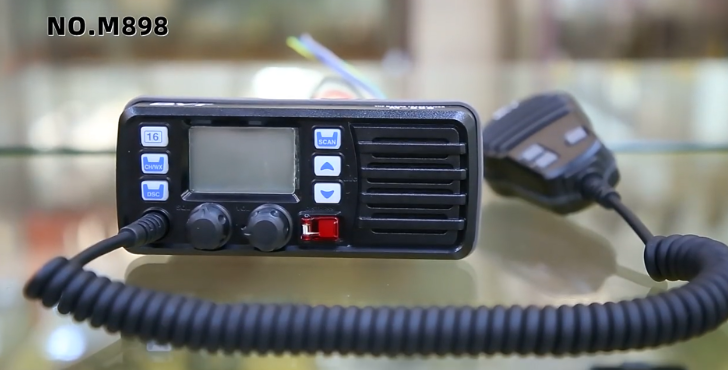
| Mobile or vehicle endpoint | KT-8900, KT-8900D, KT-7900D, KT-780PLUS, KT-980PLUS, KT-WP12, M898 | The supplied presentation lists KT-8900 and KT-8900D at VHF 136–174 MHz / UHF 400–480 MHz with 25 W VHF / 20 W UHF output; KT-7900D as a multi-segment mobile radio with up to four listed band sections; KT-780PLUS at 100 W VHF; KT-980PLUS at 75 W VHF / 55 W UHF; and KT-WP12 at VHF 144–148 MHz / UHF 430–440 MHz with 25 W VHF / 20 W UHF output. | Vehicle installation requires the correct antenna, feedline, power connection, fuse design and local authorization. Do not infer repeater compatibility from output power alone. |
QYT's official category page states that the company manufactures handheld and mobile radios and provides standard packing and customized service, including neutral or customer-logo packing. The supplied brand presentation additionally shows batteries, chargers, antennas and other accessories as part of the broader product portfolio. For project buyers, the practical next step is to send the approved frequency plan, quantity, destination market, endpoint mix and programming requirements for a configuration review.

How Should a Commercial Buyer Compare a Repeater System With Higher-Power Handhelds?
| Decision factor | Higher-power handheld only | Repeater-based system |
|---|---|---|
| Site coverage | Limited by handheld antenna height and terrain | Can improve link geometry through an elevated fixed site |
| Fleet consistency | Simple to deploy if all users share one channel plan | Requires coordinated input/output programming and site equipment |
| Capital requirement | Lower initial infrastructure cost | Higher infrastructure and site-engineering requirement |
| Maintenance | Mainly radios, batteries and chargers | Radios plus antenna, duplexer, power, grounding and site maintenance |
| Best fit | Small or compact work areas | Large sites, multi-zone operations and fixed fleet routes |
| Main risk | Dead zones remain unresolved | Incorrect frequency, duplexer, antenna or license planning can affect the whole system |
The best purchase is not always the radio with the highest advertised wattage. Buyers should compare the full delivered system: permitted frequency, antenna installation, programming, spares, documentation, delivery configuration, testing and after-sales support.
Review the QYT KT-9900 mobile radio page when evaluating a vehicle endpoint. The page describes the product as a mobile radio; the buyer should request a project-specific confirmation before using it in a repeater network.
What Should a Site Acceptance Test Include?
A commercial acceptance test should be written before production and should include:
- A map of the intended service area and test coordinates;
- Repeater input and output verification;
- Transmit and receive tone verification;
- Indoor, outdoor, vehicle and boundary test points;
- Voice intelligibility result at each point;
- Call setup, release and reconnect behavior;
- Battery state and radio power setting during test;
- Backup-power and restart test;
- Antenna, connector, grounding and weatherproofing inspection;
- Programming-file version and serial-number record;
- Corrective-action process for dead zones or abnormal noise.
A coverage claim should be tied to this record rather than to a single line-of-sight distance. If a project requires full coverage of a mine, port or farm, the buyer should specify how many dead zones are acceptable and whether a second site or portable repeater is required.
What Are Practical Commercial Deployment Scenarios?
How Can a 30 km Farm Coverage Project Be Structured?
For a large farm in South America, a 30 km cross-zone repeater plan can be structured around one elevated repeater site, mobile radios in vehicles and handheld radios for field teams. The engineering brief should define the highest practical site, antenna and power system, the approved channel pair, test points around the farm perimeter and a fallback communication procedure for terrain shadow areas.
This is a planning scenario, not a published customer case. The 30 km figure should be treated as a project target until a local site survey and acceptance test confirm the result.
How Can a Port Combine Vehicle, Handheld and Repeater Communications?
For a port in the Middle East, a three-tier design can combine a fixed repeater, mobile radios in vehicles and handheld radios for yard, gate and maintenance teams. The buyer should separate work groups by channel or tone, define dispatch priority, document emergency traffic and test the system around cranes, warehouses, steel structures and vehicle routes.
This scenario also requires local regulatory confirmation. The port operator should not treat a commercial repeater as an unlicensed consumer-radio installation merely because the endpoint radios are handheld.
What Should Buyers Ask a Walkie Talkie Repeater Supplier Before Ordering?
Use this checklist during RFQ or supplier comparison:
- Can the supplier review the approved input/output frequency pair?
- Does every proposed endpoint cover the allocated band?
- Can the supplier pre-program channels before shipment?
- Will the supplier provide a programming file and version record?
- Are the antenna, duplexer, feedline and power components included or excluded?
- What tests are performed before packing?
- Can the supplier support OEM or customer-logo requirements?
- Which export and customs documents are available for the shipment?
- What warranty period and remote technical support are included in the final sales agreement?
- Which items remain the buyer's responsibility: license, site construction, tower, installation, frequency coordination and local inspection?
QYT's internal training materials describe the factory as providing handheld radios, mobile radios and related accessories, with customization available. The supplied brand presentation positions QYT as a manufacturer with in-house R&D, production, sales and service, and describes OEM/ODM support for radios, batteries and chargers. The same internal materials identify a normal one-year after-sales period for radios, subject to the final commercial agreement. The brand presentation also displays conformity, MSDS and quality-management documents; buyers should request current, model-specific copies rather than treating a presentation image as a universal certification. Buyers should have the exact warranty scope, accessories, documents and support commitments written into the purchase contract rather than relying on a general product description.
FAQ: What Do B2B Buyers Ask About Radio Repeater Coverage?
What Is a Walkie Talkie Repeater and How Does It Work?
A walkie talkie repeater receives a radio signal on one frequency and retransmits it on another, usually from a higher site. Fleet radios must be programmed with the correct receive frequency, transmit frequency, offset and access tone.
How Far Does a Repeater Extend a Walkie Talkie Range?
Coverage depends on antenna height, terrain, buildings, frequency, power, antenna losses and interference. Planning values in this guide range from 15–25 km for a 10 m rooftop to 60–100 km for a 100 m hilltop in flat-terrain planning conditions.
Do I Need a License to Set Up a GMRS Repeater?
In the United States, GMRS requires FCC authorization. Commercial VHF/UHF repeaters generally require a separate authorization or coordination process. Confirm the current rules with the regulator before ordering or transmitting.
How Do I Program a Walkie Talkie to Use a Repeater?
Enter the repeater output as the radio receive frequency, the repeater input as the radio transmit frequency, then add the approved offset and CTCSS/DCS tone. Verify the codeplug by reading it back after writing.
What Is a CTCSS Tone and Why Do I Need It for a Repeater?
CTCSS is a sub-audible access tone used to control which signals open or activate a repeater. It does not encrypt the conversation or increase range, and the exact tone must come from the approved system plan.
Can CB, KT and M Series Radios Use the Same Repeater?
Not automatically. QYT's CB, KT and M families cover different product categories and configurations. The repeater band, channel plan, radio mode and product specification must match before a mixed fleet is approved.
What Is the Next Step for a Commercial Repeater Radio Project?
Send the supplier the deployment country, site type, required coverage area, approved or proposed frequency plan, number of handhelds, number of mobile radios, repeater-site details, programming requirements and document requirements. QYT can then review whether a CB, KT or M series endpoint configuration fits the project and identify the required accessories and pre-shipment programming scope.
Contact QYT Electronics through the official website to request a project review. Do not include confidential frequency authorizations in a public comment; share them through the appropriate commercial channel.
